Wednesday, August 24, 2016
International and Domestic
On the domestic front, our kitchen remodel is almost complete. The project took six weeks rather than the planned three. Washing the dishes in the laundry room sink is not my idea of a good time. Will post pictures soon. Really loving the whole look and function.
Because we have been putting in so much effort and money into our new home, there is not much left to travel (time and money). But, that is not stopping us from making plans. Portugal seems like a very interesting place and we are looking into the Rick Steves' tour of Portugal for the Spring of 2018.
The biggest downside to overseas travel for both of us has been the effect of jet lag. It can almost ruin the trip. Even planning two extra days before the actual tour does not seem to get us past it. But, we have a plan. Met a fellow last December in Puerto Vallarta who travels extensively and he shared that jet lag has the same effect on him. He has found a solution. Rather than flying to his overseas destination, he travels on a relocating cruise ship crossing the Atlantic. Taking 10 to 14 days, you are able to slowly get used to the time change. The cost of the cruise is approximately the same as a one-way business class ticket.
So, our plans will include a transatlantic cruise in mid-April embarking in Miami and disembarking into Lisbon, Portugal. Fingers crossed for making this work for us in a year and a half.
Monday, February 29, 2016
2015 Winter Sun Fix
And it was fun to go there again in 2015. Tom and Kate have been wintering in PV for 15 years, we were able to take advantage of their local knowledge of the best shops, restaurants/bars, and attractions. The timeshare/hotel has nice pool area and well-stocked bar plus a protected little beach to find seashells--nice way to spend the warm, tropical day. But, by far, this time around, it was the restaurants we enjoyed most (of course 30 years ago, it was all about the bars!--see photo above right). Some restaurants we visited were upscale with stunning ocean views, others quirky, and a few with quaint little flowered courtyards--the food was all fresh, prepared perfectly, and priced beyond reasonable. I ordered the shrimp over and over again.
With temperatures in the mid-80 degrees and cloudless days, we got our sun fix.
Tuesday, February 2, 2016
Ceilidh
“On long, dark winter nights it is still the custom in small villages for friends to collect in a house and hold what they call a “ceilidh”. Young and old are entertained by the reciters of old poems and legendary stories which deal with ancient beliefs, the doings of traditional heroes and heroines, and so on. Some sing old and new songs set to old music or new music composed in the manner of the old.”
— Mackenzie, Donald A., Wonder tales from Scottish myth and legend, 1917
Our tour guide, Paul, described a recent birthday party for his nephew. Attended by young teenagers and parents, the gathering started with rap and hip-hop music to the dismay of all the adults. But, the parents figured it was the kids’ party and they would support whatever they wanted; although Paul had made up his mind to make a short evening. Without any prompting about 30 minutes in, the kids pulled out an assortment of fiddles, accordions, drums and guitars and began playing the traditional Scottish tunes. Everyone joined in with the singing and dancing. The party became an spontaneous Ceilidh and no one left until dawn.
Wednesday, December 2, 2015
Starting in Inverness
It has been four months since our trip to the Scottish Highlands. If I do not take the time to journal this, the bits of information will be forgotten….
Inverness is the hub for visiting all the sights and sites in the Scottish Highlands. Not necessarily a tourist destination by itself, we still found the city charming with cute little stone houses and grand ones and old churches with ancient tipped, sunken headstones. Many people pooh-pooh Inverness, but I thought it was wonderful. The hubby and I would have an early breakfast and walk the residential neighborhoods (the photo above right captures one of the homes along our walk).
Especially loved the old used book store, Leakey’s, in Inverness. Using an old converted church, the shop is stocked from floor to ceiling with used books and antique prints. Peeking in between the bookshelves are stained glass windows with the streaming light filled with dust from the old paper. And of all things, a large wood burning stove to take the chill off sits right smack in the middle (chilly seems to be a year-around thing for Scotland).
[Photo of Leakey’s from Pinterest, photographer unknown. Too busy looking at books and prints to fiddle with the camera! The photos above I actually took/obviously.]
We have a friend (Hi, Tom), who loves to read every day and loves to collect hard back books. Tom and Kate’s living room has bookshelves also from floor to very a high ceiling filled with books (but they don’t live in a church/smile). I believe Leakey’s should be one of their bucket list places to see. It was on my list! I walked away with a small print of two kilted Scotsmen fishing in a loch (circa late 1800s). It is now framed and hanging proudly in our living room.
Friday, September 4, 2015
History Lessons from Paul Martin
Continued retelling of our July 2015 trip aboard the barge, Scottish Highlander, and our passage down the Caledonian Canal in the Scotland Highlands.
History lessons from a passionate and informed guide will always make the past come alive. And Scotland came alive for us. From the battlefield of Culloden to the massacre at Glencoe, we experienced the Scottish Highlands via Paul Martin. Being from Wales, Paul has a lot of sympathy/empathy for the people of Scotland at the hands of the English. And, I am sorry, but why are the Royals/Aristocrats still major landowners in Scotland? Time to break free Scotland! Hope the vote for independence succeeds in the future.
In addition to the lessons, Paul made arrangements for various cultural “events”. In Inverness, a trio singing and playing traditional instruments with song arrangements given a modern twist. Another included our barge approaching a remote location along the Caledonian Canal, and encountering an elderly Highlander dressed in his clan kilt, marching slowly while playing his bagpipe. The music was haunting as it echoed off the valley hills. Well done, Paul! Well done!
Paul also provides his services on the French canal trip for European Waterways. He fell in love with the French countryside so much that he and his wife purchased an old farmhouse, barn and surrounding acreage for their retirement. And he is a talented artist (30 years of painting and quite well known in the UK). The barn in France will become his studio with plenty of space for workshops. His plans include building small cabins for visiting artists to rent whilst (he says that a lot) attending his workshops. Guess who is invited and going in a few years?! Moi! et Madame Wanda.
Wednesday, August 5, 2015
Captain of the Canal
Took me a little while to find a photo of our Scotland cruise barge captain, Mick. He was usually in the wheelhouse and not often available to chat. The last night of our trip was his time to relax and enjoy a meal with us all (and plenty of wine since he wasn’t on duty the next day). And we got to know Mick, just little bit.
Always a few degrees of separation, we learn he captained in the Caribbean for The Moorings—the same outfit our travel partners, John and Wanda, sailed with on a couple of occasions. It was probably just by chance that Mick didn’t captain their trip and they knew many of the same people. Mick is now in Scotland to be closer to his hometown of York and captain a larger vessel with European Waterways which allows him enhance his captain’s credentials.
Our captain expertly got us through a number of small locks (photo at right), the narrow canal channel, large lochs (past the Loch Ness monster), and ancient tiny bridges (including a swing bridge still hand-cranked open).
Our lodging for the week was on the barge, Scottish Highlander. Originally a cargo barge operating in Holland built in 1931. It was 117 feet long and converted to a hotel barge in 2000. A maximum of 8 passengers to 4 staterooms and 4 crew members (captain, tour director, chef and hostess—also worked as deckhands!) assigned to a private stateroom each. Each stateroom had a private head or bathroom.
Sunday, July 26, 2015
Classic Scotland Cruise
Returned from Scotland about a week ago. Jet lag and the flight took a toll this time, so my writing has lagged behind a bit. Scotland is wonderful—people, location and history. Checked all my boxes.
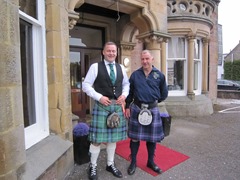
This trip was aboard a barge. Built in the 1930s as a working barge and renovated now as a luxury passenger vessel cruising the Scotland Caledonia canal. But, the best part of the trip was the staff and other passengers—4 staff members and 8 passengers, and the Scotland Highlanders we met. The two kilted fellows in the photo right were attending a wedding near our hotel in Inverness (our two days pre-trip). “May we take your picture?” With a laugh, they both replied, “Aye!”
The barge staff included Mick, our captain; Paul, tour director; Danni, host, and Sasha, the chef. Each one with a story, personality plus, and outstanding service. Let’s start with Danni and Sasha (Danni on the left, Sasha on the right).
Danni is 28 years old originally from Dublin, Ireland and an aspiring circus performer. She attends specialized schools in the off-season to improve her craft. Her skill includes a combination of dance and acrobat. No doubt, we will see her in Cirque du Soleil some day. Depending on her school location (this year will be Spain), she also teaches English to help pay for school. Last year she was attending school in Argentina and teaching youngsters English (with an Irish accent, mind you). She tells a story of setting up the movie, “Up”, for the kids—only they learned it from Danni pronounced as Ooop (the Irish way). The headmaster was baffled what movie they were actually seeing until Danni showed him the DVD cover.
Sasha is the best cook I have ever encountered. I gained five pounds in the 7 days we stayed on board. Each meal was a classic Scottish dish, but with a modern twist, i.e., Haggis with a whisky reduction sauce. Sasha hails from Slovakia and hopes to open a restaurant there someday. I plan on going…
Tomorrow, I will highlight Day 1 on the cruise and introduce Mick and Paul.
Sunday, January 4, 2015
Adriatic Tour–Plitvice National Park
Our arrival to Plitvice National Park was in the misty rain. Fantasy genre movies wait for this type of atmospheric setting. Where little raindrops glitter the heroine’s hair as she walks through the woods. Not exactly the dewy young maiden (ha,ha), but I did appreciate these conditions for seeing this natural wonder. It made the whole experience mystical.
Sixteen terraced lakes spill into one another—you are literally surrounded by waterfalls. With boardwalks crossing many of the lakes bringing you up so close you can feel the water crashing over the edge.
The first shots of Croatia’s war were fired here in 1991. For almost five years no one visited the park. What was once a down-trodden park from so many visitors the environment was able to recover. The water was now pristine. Thousands of fish on the surface thriving. Delicate flowers and colorful salamanders on the hills. From such a sad plight of war, maybe one good thing happened.
Adriatic Tour–Dining
One of the many things that make a Rick Steves tour special is their ability to use locals to find the special places and people of that country that you will not normally see on your own or on a large tour group. One of those places on our tour was a wonderful locally known restaurant known as Brtonigla located on the Istria Peninsula.
We were warned to bring an appetite and they did not joke about this... From quick tasty bites of the appetizer, to a several mouth-watering main courses (at least I considered them to be large enough for a main courses) to the sweet dessert, we enjoyed the view, the company, the owners and the whole darn thing. Their meats are actually cooked on open flame in a huge fireplace looking grill!
Saturday, December 20, 2014
Adriatic Tour–Romantic Rovinj
All of this tour was trip of a lifetime, but there are a few places that will stay in my heart. One of them was Rovinj, Croatia and we were only there a few hours. I so wanted to spend more time in this special little town. Spilling out into the Adriatic and surrounded by fishing boats, the old town is filled with small cobbled alleys sometimes leading you to some new interesting location and sometimes ending abruptly. Little sobes (apartments for rent and oh, so, cute!—Wanda has her eye on the one in the photo right), art galleries, and restaurants line the streets and alleys. And like a tiered wedding cake, the top (hill-top) is adorned—in this instance with a bell-towered church.
A pleasant cultural and architectural mash-up between Italian and Austrian. Austrians enjoyed the location as a vacation destination during the Hapsburg rule (pre-World War I) and Italians during their ownership between World Wars.
Sigh. Just a few more days, please!
Saturday, December 6, 2014
Adriatic Tour–Pula’s Roman Amphitheater
The Pula Amphitheatre located on the coast of Croatia is remarkably intact. [Photo taken by Adria Hirsch from our tour group.] It was crowded with tourists the day we visited; but I suspect it is less crowded than the more well-known structures like Rome’s Colosseum . Visit to the “basement” of the amphitheater where once lions and other exotic animals and gladiators waited before their turn for a battle to the end. All for the enjoyment of the elite and ordinary civilians--around 20,000 could fill this arena--although I find it hard to understand the watching pleasure as the beasts tear a human apart. Today’s events include music concerts and film festivals.
The subterranean level also displays found intact jugs or amphorae some still containing olive oil and wine. The bottoms rounded to allow rocking in the bottom of the ship. Think about it—this is close to 2,000 years old. Hard to wrap your head around, isn’t it?
Throughout the old town (Pula is a big city; the tourist portion is small and very easy to walk) you find more remnants of the Ancient Romans. Seems every time an “empty” lot is readied for a new building more ruins are found. Very much a working city, Pula has a grittier and busier feel to it than the places we have visited so far. Still a beautiful place by the Adriatic.
Sunday, November 30, 2014
Adriatic Tour–Motovun, Croatia
When I first read that our tour would include a 2-night stay in a castle, I was excited, but a bit apprehensive. Never in a castle before; the vision was cold and drafty for sleeping. Fascinating to view. Uncomfortable to stay.
Imagine my surprise when I realize this small hill-top castle (every town on a hill for defensive purposes) in the little place called Motovun included inviting warm rooms with very comfortable beds each with a full en-suite bath (with marble no less). Our shuttered windows opened outwards (so Romeo and Juliet) to a large courtyard filled with trees and a small restaurant. Surrounded by the low fortress wall allowing overlooking the valleys and other distant villages balanced on top of the surrounding hills. In the morning, a thick mist would hang in the valleys making the villages float above the clouds.
All Quiet. Except a strange “cawk” sounding owl at night and a nearby rooster making sure we did not oversleep in the morning.
One extremely steep, narrow road leads to our hotel (one road for the whole village, actually!) and the way is lined with little homes and small stores containing truffles, Adriatic Sea salt, and local hand crafts. All tidy, but with the inevitable eroding of the stone fronts and cobblestone over so much time. Our bus can only make it part way; so we puff, puff hiking up to our destination.
Note: Photos courtesy of my new-found tour buddy, Adria Hirsh. We focused on the same photo opportunities, but she has a better eye and a better camera! Thank you, Adria!
Tuesday, November 25, 2014
Adriatic Tour–Lisjak Winery
Good people. Good wine. Good food. Set in the wonderful Karst region in Slovenia (you know with all the charming hilltop towns on the Italian border) is the Lisjak Winery owned by Boris Lisjak and his family (photo to the left is Boris and his grandson). The whole family is involved right down to the grandkids. And when it is time to harvest the grapes the whole village rallies to pick. The cabernet sauvignon was so fine I lugged a bottle back home.
Our tour group stopped at Boris’ winery and vineyards for his excellent wine and home cooked dinner. Shared in his lovely family home and wine cellars. By now our tour group members are becoming close friends and we are having a great time especially with a few glasses of vino. White wine. Wred Wine (after a few the extra “w” just happens). Now, every good story has a special recipe and here is the Cabbage Soup we loved with dinner:
Lisjak Cabbage Soup
500 grams of sour cabbage (also known as sauerkraut)
200 grams of potatoes
300 grams of beans
1 onion
1 teaspoon of sweet pepper powder
bay leaf, salt, pepper
In the first pan you should cook sour cabbage, second pan should have salty water and sliced potatoes in it and the third pan beans with bay leaf. Afterwards sautee chopped onions and sweet pepper, add sour cabbage with water in which it was cooked, add cooked and mashed potatoes and brown beans. At the end add the water from the beans to get a thick stew, add salt and pepper. For better taste you can also add a sausage (that you have previously cooked in a separate pan) and then add it after it is cooked for about 5 minutes.
Bon appetite!
Saturday, November 15, 2014
Adriatic Tour–The Karst Region
As we leave the Soca River Valley and up over a ridge, we drive into some of the best wine-making area of Slovenia. The Karst Region. You can easily see Italy in the distance. Hilly country-side with a dry Mediterranean climate needed for growing great grapes. We stopped at one of the hill-top villages named Smartno. A favorite day trip for our guide, Tina, and her husband on one of their rare days off work and spent together (they are both guides for Rick Steves Tours). Pictures will do a better job describing this charming place with cute boutique shops. And no, I am not waiting for an opportune time to take pictures without tourists. They simply are not there. Another plus of this particular tour.
Thursday, November 13, 2014
Adriatic Tour–Soca/Italian Front and World War I
Tumbling down the slopes of the Julian Alps, the Soca River is milky green-blue color, fast-moving down the mountain and cuts a mean slot canyon through the rock. Our road follows along the river and passes through small villages. The active wear company, North Face, filmed on location here. The ad on Vimeo is worth watching to really get an idea of the spectacular beauty of the area. http://vimeo.com/97101261 This beautiful, gentle valley was the location of some of the worst fighting and conditions during World War I.
It is only fitting so near to Veteran’s Day that this blog post describes our visit to the Soca River Valley also known as the Italian Front (part of the Eastern Front) during World War I. The Julian Alps and the valley have reminders of the war especially the many cemeteries—nicknamed the “Valley of Cemeteries”—thousands of graves dot the hillsides. One devastating war after another, you would think the human race would remember and learn from our mistakes.
Ernest Hemingway’s novel, A Farewell To Arms, was set here and tells a story of his time spent as an ambulance driver during World War I. I had good intentions of reading the book before the trip; but frankly I struggled to get through The Old Man and The Sea, as required reading in school. Since I have visited, maybe I will give it another go. The area likes to link to Papa Hemingway, especially the village where we spent the night, Kobarid. (The village is known by its Italian name, Caporetto, in the novel.)
In Kobarid we visited the small, but very well-done museum of the Soca Front and World War I. Pictures of the common people (locals, soldiers, nurses) from all sides of the war. Their daily lives, the war strategies/weapons, and the casualties and results of the fighting—over one million died. The museum docent asked that we not take photos of the displays, especially the ones containing pictures of the people.
Had to stop short of completing the museum tour; just too overwhelmingly horrible. Medical attention during the war was minimal and the medical advancements we have today for our soldiers were non-existent in the early 1900s. Those who survived were severely disfigured or suffered internally from chemicals. Photos showing the injuries were displayed and I can understand why we were asked to refrain from taking pictures.
A learning experience, but a tough pill to swallow.
Saturday, November 8, 2014
Adriatic Tour–Julian Alps
Up and over the Alps—the Julian Alps—via the Vrsic Pass and the Soca River Valley. I have been over my share of mountain passes, but never one with 50 hairpin turns (24 up, then 26 down). Each one is marked; so there is no denying the count of 50. And never in a large tour bus. The bus would turn ever so, s-l-o-w-l-y, around each.
Our first stop at turn #8, included a quick hike up to a little Russian chapel. A memorial to 10,000 Russian POWs who died building this mountain pass during World War I. Not killed by gunfire, but rather the elements (cold and avalanche) and illness. The chapel was built where the final casualty was found. The wood of the chapel looks like copper. It had that glow in the lowlight of the forest. I had to touch it to be sure it was wood. Beautiful and lovingly maintained.
Next stop at a mountain-top restaurant for some hot chocolate. Had to chuckle at the sign. Bikers Welcome. In the States, a Bikers Welcome sign would indicate a stop for the local Harley motorcycle club. Here, well you can see for yourself in the photo to the left. A group of French adventurers! Only know a bit of French, but a shout out of “Comment Ca Va?! (how’s it going?) to the group brought out the smiles and waving back with the comeback of, “Bien, Merci!” (good, thank-you!) We saw them buzzing past as we headed down the mountain still waving a happy good-bye.
Friday, November 7, 2014
Adriatic Tour–Ski Jump
Never saw a ski jump before this trip. And I did not expect to see anyone jumping in September (no snow). Before our tour headed up and over the Julian Alps, we made a quick stop at Planica and watched Olympic hopefuls fly off one of several ski jumps and land gracefully on…..looked like some sort of green PLASTIC! I held my breath when they ejected from the end of the jump, hanging in the air for the longest time and finally I exhaled when they safely came back to earth.
This is the largest ski jump in the world. The location is within Slovenia borders but a short walking distance to Italy and Austria. Another wow. (Photos courtesy of Russ Ruda. One of many great guys on our tour.)
